
Trumbull County Court Record Requests
Pick the right keeper first. The Trumbull County Clerk of Courts holds Common Pleas General Division, Domestic Relations, and Trumbull-originated appellate filings. Probate, Juvenile, the Central and Eastern Districts, Warren Municipal, Niles Municipal, Girard Municipal, Newton Falls Municipal, and mayor's courts are separate. Each keeps its own files at the court level. The Clerk's Public Access Records Search can locate Common Pleas or Domestic information. Ohio offers no statewide case-search portal covering every county court file.
Without a case number, a docket search is the practical starting point. For Common Pleas and Domestic matters, use the Clerk's terminal search. It takes a party name or a case number. You can also visit the Clerk counter, call, or mail a documented written request. That written request lets the Clerk run a name search for you. Probate has its own online request form. Domestic Relations takes filings in person or by mail. It does not accept faxed or emailed filings.
Routing in Trumbull County depends on the division, not just the subject. A General Division file goes to the Clerk of Courts. A Probate matter goes to Probate. A lower-court matter goes to the local court that keeps it. That split is why an accurate case number and court name make any request work better.
| Trumbull County record need | Trumbull County custodian route |
|---|---|
| Trumbull County Common Pleas General Division case | Trumbull County Clerk of Courts and its public terminal or eServices route. |
| Trumbull County Domestic Relations case | Trumbull County Clerk channel or Domestic Relations Clerk, depending on the record requested. |
| Trumbull County Probate case | Trumbull County Probate Court public-records request process. |
| Trumbull County Juvenile case | Trumbull County Juvenile clerk and Family Court process, subject to access limits. |
| Trumbull County Central or Eastern District case | The assigned Trumbull County Court district clerk and record-search channel. |
| Trumbull County municipal or mayor's-court case | The Trumbull County-area court clerk that holds the territorial case file. |
Match the request details to the record type. A Trumbull County case number and a party name help. So does naming the court or division. Together they point your request toward the right records channel.
The request works best when it names the court, the division, and the item. A Clerk search letter differs from a Probate form because a different office processes it. The same detail separates a terminal search from a lower-court record request.
- Identify the court, division, and case number if it is available. Court territory and subject matter determine the correct custodian.
- Decide whether the need is inspection, a docket entry, a filed document, a plain copy, a certified copy, a transcript, or an archive record.
- Use the relevant online record channel or a Clerk terminal to locate the file. Bring a party name or case number for the published terminal search.
- Request the specific item from the clerk or court that maintains it. A written Clerk name-search request must state the name, the period to search, and include the listed fee.
- Confirm copying, certification, delivery, and any identification requirements with that custodian before relying on the result.
For a transcript, contact the court or court reporter tied to the case. The Clerk publishes no single blanket transcript charge. So a general transcript fee cannot be assumed.
Trumbull Court Records at Probate
Probate runs on its own records route. The Trumbull County Probate Court public-records request form asks you to describe the record. Add a case name and number when you can. Certification and delivery choices are built in. The court contacts the requester with the final cost once its records clerk locates the record. It publishes no fixed processing time.
The official Probate request form shows exactly what the court asks for.
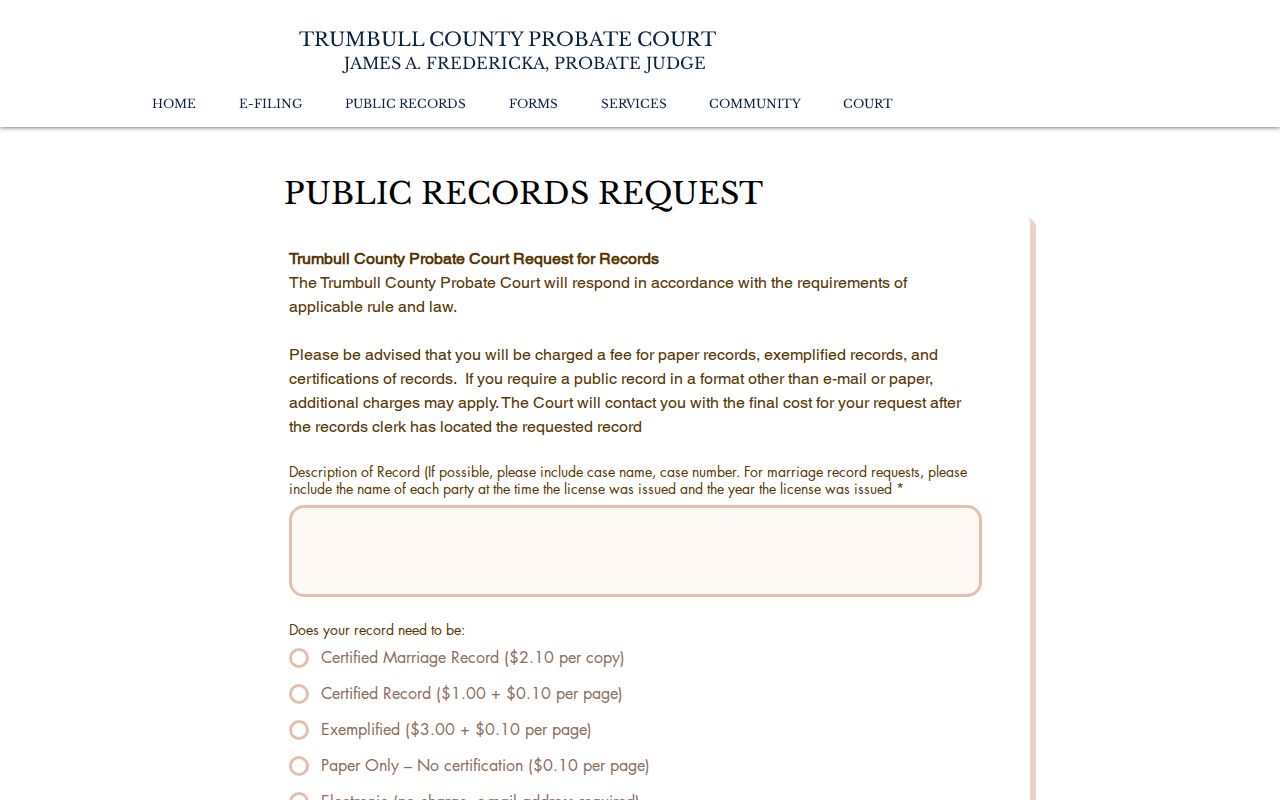
Mail delivery needs a mailing address and postage paid by the requester. Electronic delivery requires an email address, stated plainly on the form. An electronic email copy carries no listed charge. Paper-only and certified options have their own published amounts. Remember, this route covers only Probate-held matters. The Common Pleas Clerk is separate. So is a municipal court clerk.
For a Trumbull County Probate request, describe the Probate record rather than using a General Division or municipal-court route. The Probate form keeps its delivery and certification choices separate from what other Trumbull County offices offer.
Kinds of Court Records
Trumbull court case records come in more than one form. An appearance docket is one kind. So is a modern docket. Both are the court's running index of activity. The case file holds the pleadings, orders, judgments, and other filed material. A certified copy is different. It is an official copy issued by the court or clerk. Not every filed document image is freely available through a public web search.
- Docket or appearance docket: the running case history or historic index used to find entries, dispositions, and record-book locations.
- Filed document: a pleading, order, judgment, or other item in the case file held by the appropriate court.
- Plain copy: a copy supplied by the custodian without official certification.
- Certified copy: a copy issued with the court or clerk certification requested for the item.
- Historic record: a journal, record book, appearance docket, case file, or microfilm material described by the County Records Center.
- Transcript: a separate court-reporting record obtained through the court or reporter connected with the case.
Files cannot be signed out from the Clerk. Ask for the exact record type so you don't mistake a web display for a document it never claims to be.
Trumbull County records can pass through different custodians. The phrase "court record" sounds the same either way. An appearance docket, a case-file document, and a certified copy are three distinct requests with distinct uses.
Trumbull Court Records: Three Layers
A docket and a case file answer different questions. The docket lists court activity in order. A filed document is the underlying pleading, order, or judgment itself. Certification is the clerk's act of issuing an official copy. A search screen helps you decide what to request. But it never turns a displayed entry into a certified document.
| Record layer | What it is | Practical route |
|---|---|---|
| Docket / appearance docket | Index or chronological activity history | Use the Clerk search, public terminal, lower-court Record Search, or archive index. |
| Filed document | Pleading, order, judgment, or other file material | Ask the court or clerk that keeps the case file for that item. |
| Certified copy | Official copy issued by the custodian | Request certification from the relevant clerk or court and confirm its fee. |
Remote access to Trumbull County court records is one thing. Walking up to the counter is another. Under Ohio Superintendence Rule 11.12, remote access is optional. Even where the court or clerk allows it, attachments can be left out. So a missing filing online does not mean it was never filed. Ask the office that actually holds the file.
For a Trumbull County case, the docket tells you what happened. The custodian supplies the document itself. That split holds no matter where the case began. It applies with the Clerk, Probate, Family Court, or a territorial lower court.
Direct access in Trumbull County still runs through the custodian. The case history can name a document for you. But the court or clerk decides how copies come out and applies any lawful restriction.
Trumbull Court Records: Web Search Limits
An online result is a locator, not a full file. Ohio's rules draw a line between direct access and remote access. Remote access is optional. Attachments may be missing. This can happen even when the record sits at the court or clerk for direct viewing. A web result can still give you a docket entry, a date, or a case number. The underlying document comes from the custodian's copy process.
Work in order. First confirm you searched the right court. Then allow for the posting delay that the lower-court systems publish. The item may still not be there. Request the named filed document, a plain copy, or a certified copy from the court holding the file. That sequence respects the local record split and lawful access limits.
A Trumbull County online result points you somewhere. It does not promise every attachment is posted. A direct-access request should name the case and document. It should also name the Trumbull County court or division that holds it.
A Trumbull County display may lack an attachment. Ask the custodian whether direct access or a copy request is the right channel. Naming the court keeps the inquiry with the file holder.
Court Records: What They Contain
What you can get depends on the court and on any access restriction. The County Records Center describes its historic appearance-docket index. The index helps you find party names, a case number, cause of action, disposition, journal entries, and record-book location. That index is the searchable layer. The underlying material it points toward is separate. It lives with the office that holds the file.
| Court and case number | Identifies the court file and is the most direct way to route a request. |
|---|---|
| Caption or party information | Historic appearance-docket indexes are arranged by plaintiff and defendant. |
| Cause of action | The case type or basis of a civil matter, recorded in the archive index where available. |
| Journal entry | A formal court entry with a record-book location in the historic index. |
| Disposition | The recorded outcome or status, not necessarily a future hearing setting. |
| File material | Underlying pleadings, orders, judgments, and documents held by the custodian, subject to access limits. |
Lower-court systems go by names like Record Search and CaseLook. Those channels can lead you to case information. The clerk remains the source for a copy or for confirmation of a record.
Archive material, Common Pleas information, and lower-court displays differ. Each describes a different piece of the Trumbull County record system. Match the court name shown with the case before you ask for anything else.
A good record description names the Trumbull County case number when one exists. It may also give the caption. It may give the cause of action. Or a journal entry may point to the document you want.
Trumbull Court Records Since 1808
A modern portal may turn up nothing. The Trumbull County Records Center and Archives offers another path. Its Common Pleas journals cover 1808 through 1975. They record daily court action in civil, divorce, and criminal courts. Record books from the same period are described as exact transcripts of cases. Early volumes may lack indexes, though.
The appearance-docket index starts from a party or subject. It leads to a case number, cause of action, disposition, journal entry, and record-book location. It also identifies execution dockets, criminal dockets, judgment-lien dockets, case files, and microfilm. Start there. Then ask for the material it names instead of stopping at a failed modern search.
For Trumbull County historical research, the appearance docket links a person or topic to a record-book location. Keep in mind what this path is. It is a local records route. It is not a replacement for the current file at a Trumbull County court clerk.
The journals and record books serve a historic-research purpose. The index lets you request the exact material its location reference identifies.
Copy Fees and Certification
The published amounts below come from the County Clerk and Domestic Relations information. They apply to the listed Clerk channels. They do not apply automatically to every municipal, county, Probate, Juvenile, or federal court. Confirm which court holds the file before sending any payment. A Domestic divorce-decree copy by mail also requires a self-addressed stamped envelope.
| Item | Published amount |
|---|---|
| Clerk-performed individual or business name search | $5.00 |
| Self-search at the Clerk office | No fee |
| Public-record copy | $0.05 per page |
| Clerk certification | $1.00 per certification |
| Clerk exemplification | $5.00 per exemplification |
| Domestic certified copy | $1.00 each, plus copy charge where applicable |
Trumbull County Clerk of Courts
Trumbull County Courthouse
161 High Street N.W.
Warren, OH 44481
(330) 675-2557
Weekdays, 8:30 a.m. to 4:30 p.m., Civil Division
Searching the terminal yourself is free. The Clerk charges when it runs a name search for you. Those are two separate services. Court-cost payment instructions do not cover an authenticated certified copy. So confirm the exact item and the office that holds it before mailing any payment.
These charges come from the Trumbull County Clerk for the county records channels listed here. A Trumbull County municipal, Probate, Juvenile, or federal record sits with a different custodian. It may carry a different fee. Name the proper file holder in your Trumbull County request.
A Trumbull County fee inquiry works best when it names the court and the item sought. That lets the Trumbull County clerk tell a plain copy apart from a certification request. It also helps the clerk quote the cost correctly. Ask before you pay.
Trumbull Court Records and Federal Files
Federal files live on a separate layer entirely. Trumbull County sits in the Northern District of Ohio. A federal civil, criminal, bankruptcy, or appellate case never appears in the County Clerk's Common Pleas portal just because the event happened locally. PACER serves as the federal judiciary's public access route. CM/ECF is its filing and case-management system.
Northern District of Ohio district information lists Trumbull among the counties that district covers.
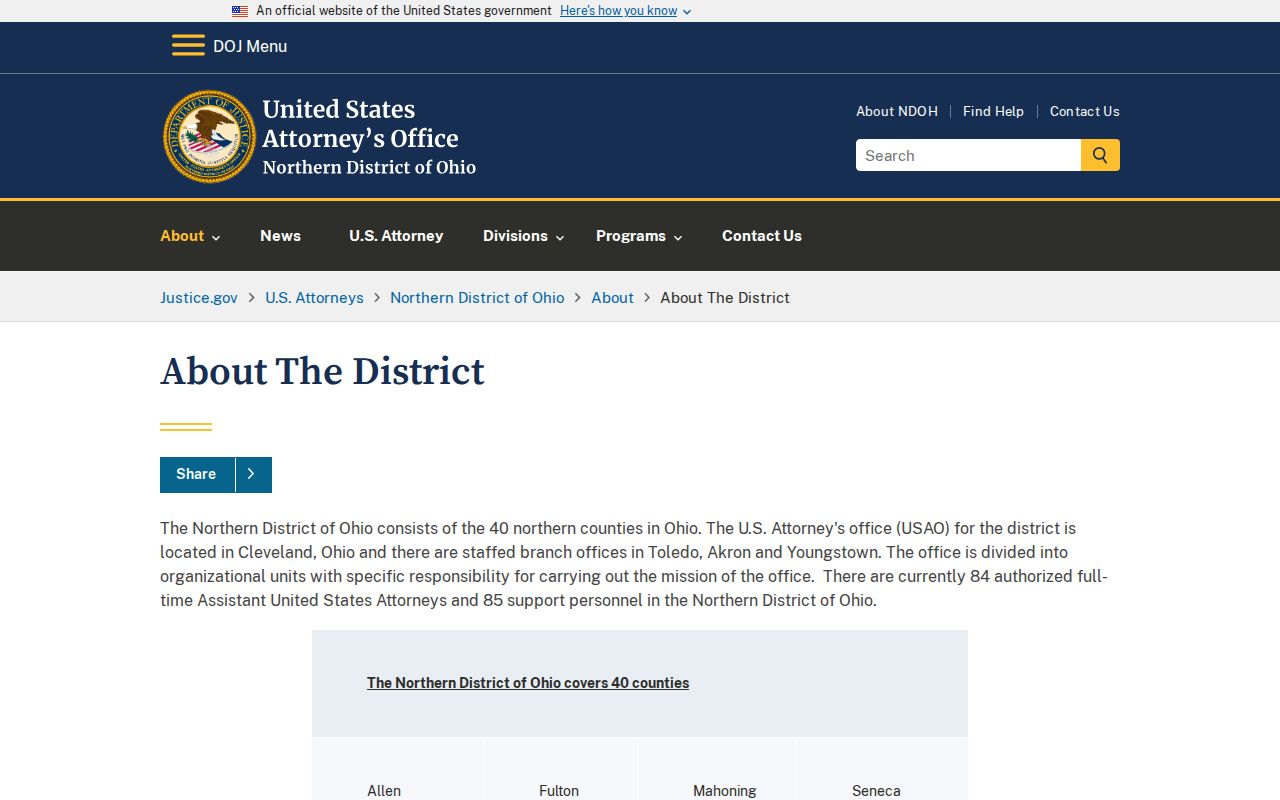
State-court custodians and the federal clerk are separate sources. Searching state cases cannot replace PACER for a federal matter. The Northern District of Ohio court site identifies the federal court system serving this area.
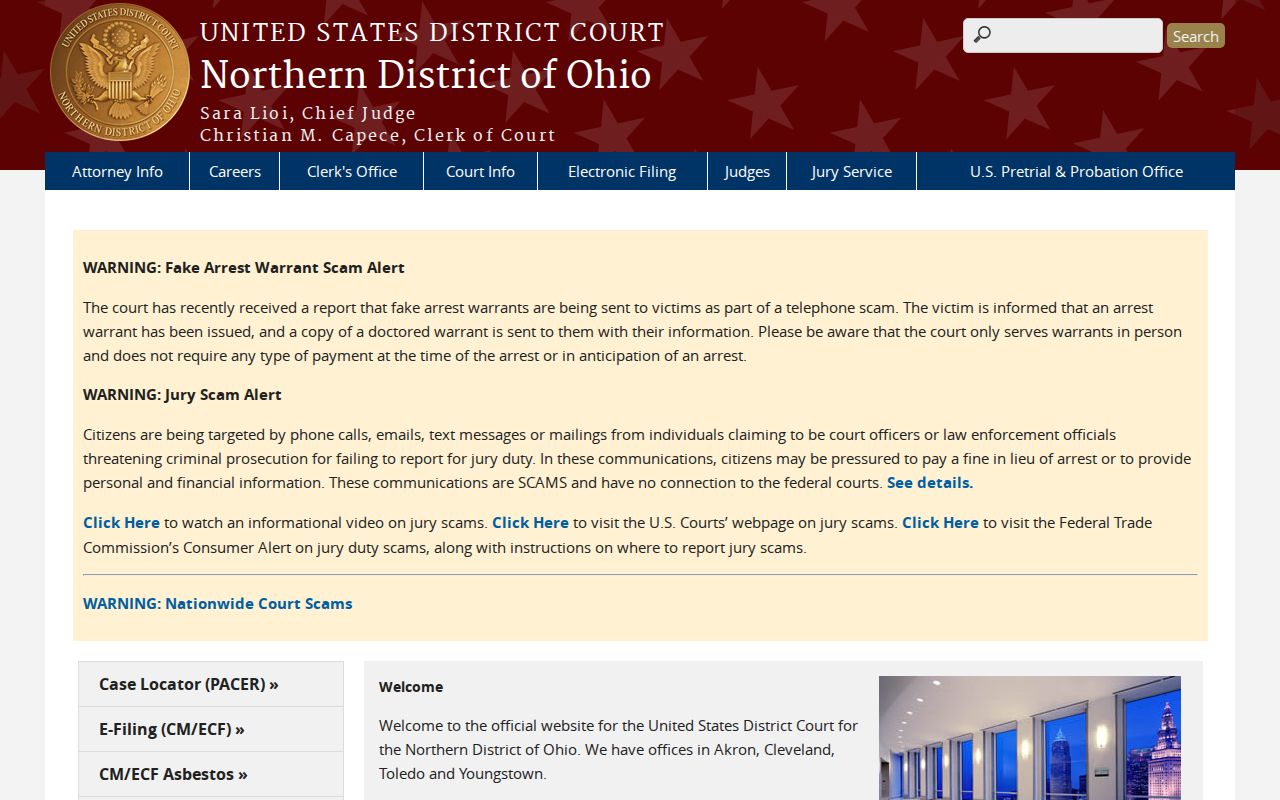
Use the federal route only for federal jurisdiction. The Trumbull state and local courts handle everything else. Youngstown federal courthouse information identifies the nearby federal location.
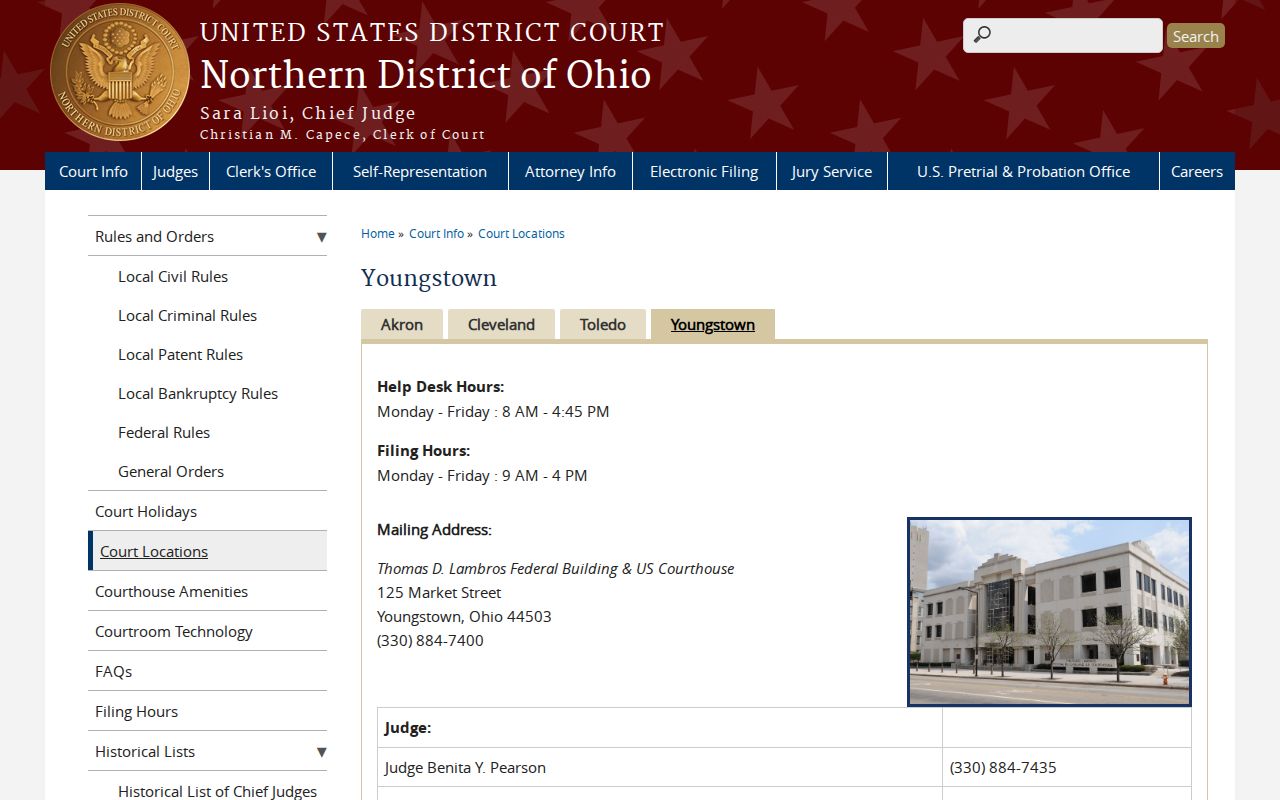
The Youngstown location is the Thomas D. Lambros Federal Building and U.S. Courthouse. Its federal filings follow federal access, account, and fee rules. Northern District court-record guidance sets out the federal copy route.
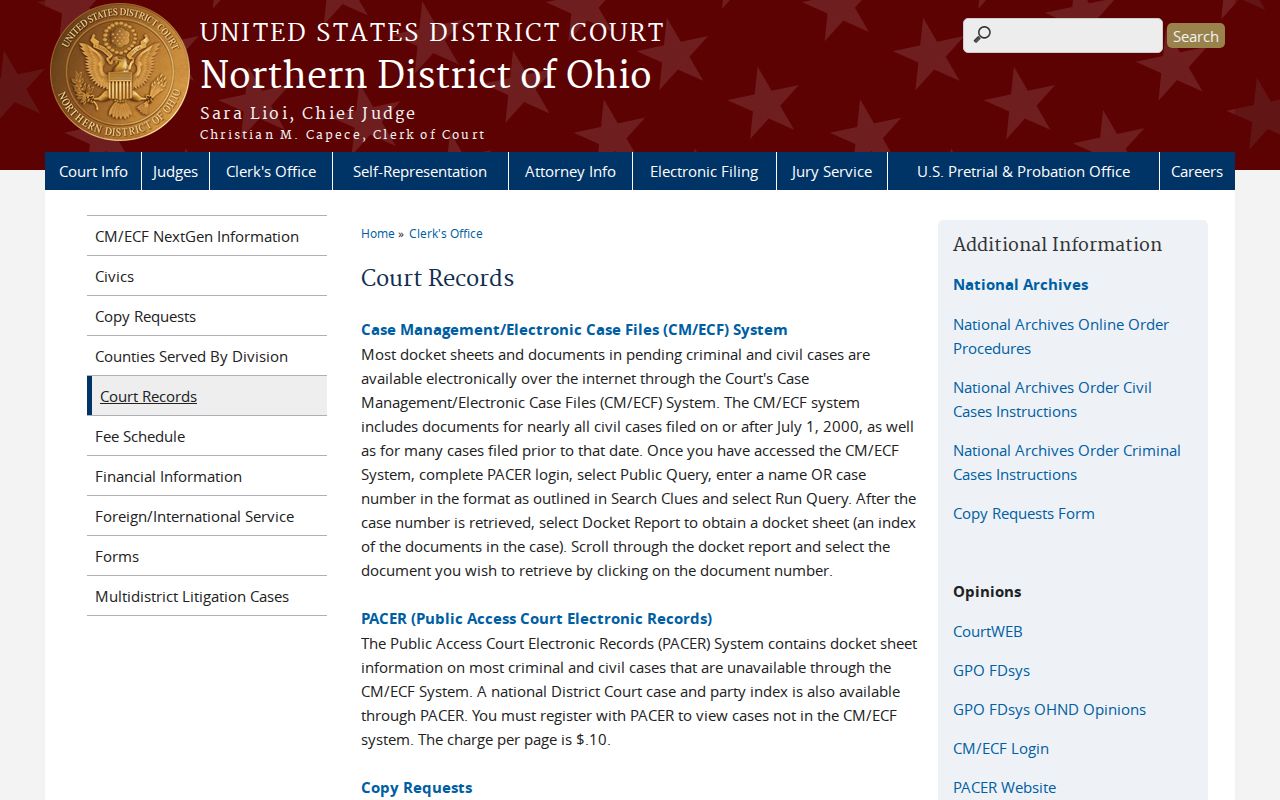
PACER charges $0.10 per page. Its report and quarterly billing rules still apply. Terminals at the Northern District courthouse are free to view. The published copy route runs $0.50 per page plus an $11 certification fee.
An event in Trumbull County does not by itself make the case a county state-court record. The Trumbull County Clerk route and the federal route stay separate. Pick the court with jurisdiction before seeking a copy.
For a Trumbull County federal matter, location is only one routing fact. The federal custodian, not a state clerk, supplies the federal docket or document. It does so under its own rules.
Access Rules for Court Records
Ohio court records are presumed open. A rule, statute, or court order can restrict access. The docket itself counts as a court document. When online access falls short, direct access is the request route: the court or clerk must make a court record available by direct access, promptly acknowledge a request, and respond within a reasonable time. Lawful exclusions and copying rules still apply.
Ohio court-record rules:
Rules 11.09 and 11.10 treat dockets as case documents and establish the presumption of public court records.
Rule 11.11 governs direct access through the court or clerk.
Rules 11.13 and 11.14 address personal identifiers and lawful access restrictions.
R.C. 2953.32 supplies an adult sealing and expungement procedure; R.C. 2151.356 addresses juvenile sealing separately.
Juvenile, sealed, expunged, restricted, and protected-identifier material may stay offline or off-limits to copying. A missing result can also mean the wrong court. A posting delay can do the same. It never authorizes a general request to override a restriction. Use the court with jurisdiction and follow its current clerk instructions.
Trumbull County access starts with the Trumbull County court that keeps the record. A records request does not override a restriction. No Trumbull County custodian can release material that Ohio law or a court order keeps restricted.
Note: The Ohio Public Records Act offers useful public-office context. A court-record request should still follow the court-access rules. It should also follow the process of the custodian holding the file.